

Bustling Fungus Risk Of Rain
Facts About the Mucus Amid Us
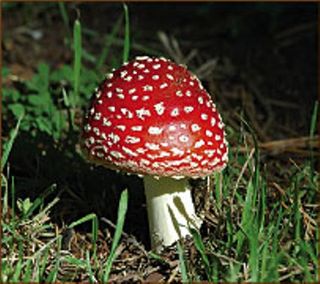
Tens of thousands of organisms, from mushrooms to mold to yeast, fall nether the umbrella of fungi. Once thought only to be plants, fungi accept emerged equally their own taxonomic kingdom. The various fungal species are diverse, with many unique properties: some innocuous, some useful and some harmful.
Classifying fungi
It has taken decades, as technology improved and scientific cognition evolved, to appropriately classify this myriad group of organisms.
As recently as the 1960s, fungi were considered plants. In fact, at that time all organisms were classified into merely two groups or kingdoms: plants and animals. In a 1969 article published in the journal Science, ecologist Robert Whittaker explained the footing of this two-kingdom organization. For many decades in history, the just living creatures humans observed effectually them were either the "rooted" plants that produced their own food, or motile animals that sought out their food. Thus mobility and the method of gaining nourishment became the criteria for a system of nomenclature. "The animals moved and plants didn't, and that's how fungi got stuck with the plants," said Tom Volk, a professor of botany at the University of Wisconsin-La Crosse.
However, dissimilar plants, fungi practise not contain the green pigment chlorophyll and therefore are incapable of photosynthesis. That is, they cannot generate their own nutrient — carbohydrates — by using free energy from light. This makes them more like animals in terms of their nutrient habits. Fungi need to blot nutrition from organic substances: compounds that contain carbon, like carbohydrates, fats, or proteins.
Based on these and other properties, in 1969 Whittaker proposed that fungi become a separate kingdom equally a office of a new five-kingdom system of nomenclature. The proposed nomenclature included a vast array of species. Amongst them, mushrooms, yeast, molds, slime molds, water molds, puffballs and mildews.
Since then, the system of classification and the fungal kingdom have been farther refined. For example, slime molds and water molds were shuttled off to a different kingdom. Today, the members of the kingdom Fungi are also known as the "true fungi."
Characteristics of 'true fungi'
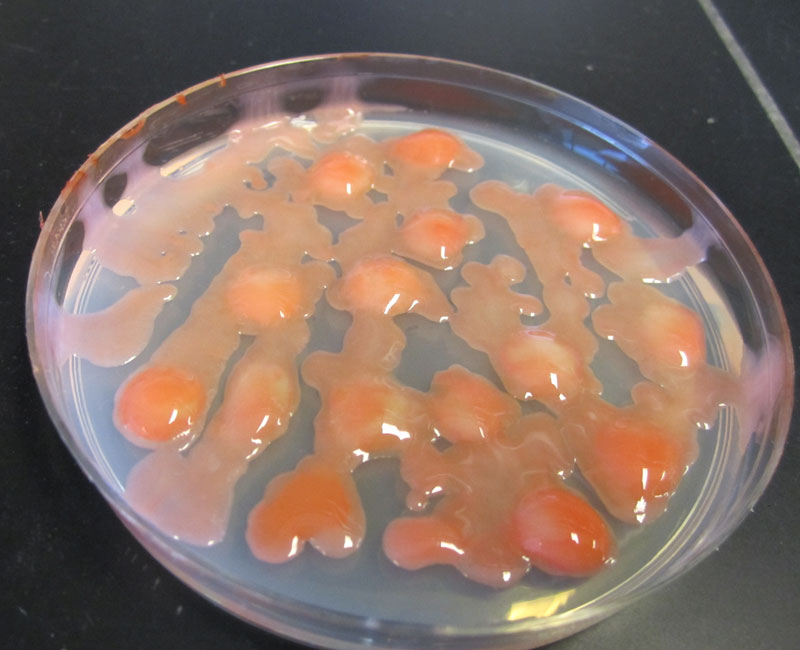
According to "Van Nostrand's Scientific Encyclopedia, Vol 1, 10th Ed. (opens in new tab)" (Wiley, 2008), the numerous fungal species have "widely diverse habits and characteristics," and generalizations can exist hard. Nonetheless, there are a few primal aspects mutual to all members of the fungal kingdom.
Cells: Fungi are eukaryotes, merely similar plants and animals. This ways they have a well-organized cell, characteristic of all eukaryotes. Their Deoxyribonucleic acid is encapsulated in a cardinal structure called the nucleus (some cells can have multiple nuclei, according to "Van Nostrand"). They likewise have specialized cellular machinery called organellesthat execute various dedicated functions such as energy production and protein ship.
Fungal cells are encased in two layers: an inner cell membrane and an outer cell wall. These two layers accept more than in common with animals than plants.
Like animate being prison cell membranes, those of fungi are made of proteins and fat molecules chosen lipids. In addition, animal jail cell membranes contain varying amounts of cholesterol. Similarly fungal membranes incorporate a unique steroid chosen ergosterol, co-ordinate to Volk.
Constitute cell walls are fabricated of cellulose, whereas fungal cell walls have chitin, a distinctly non-found substance. In fact, the exoskeletons, or the outer hard shell of various arthropods (insects, and crustaceans like crabs and lobsters) are made of chitin.
Structure: Fungi tin be fabricated up of a single cell as in the case of yeasts, or multiple cells, as in the case of mushrooms.
The bodies of multicellular fungi are made of cells that band together in rows that resemble the branches of trees. Each private branched structure is called a hypha (plural: hyphae). Most often, the individual cells in hyphae sit right side by side to each other in a continuous line (also known as coenocytic hyphae) just they can sometimes be separated into compartments by a cross wall (septate hyphae). Several hyphae mesh together to class the mycelium, which constitutes the fungal body, according to "Van Nostrand."
"The fungi are the kings of surface area," Volk told LiveScience, explaining that hyphae expand their surface area in lodge to take in food, facilitate digestion and besides to reproduce.
Nutrition: Equally mentioned earlier, since fungi cannot deport photosynthesis, they need to absorb nutrients from diverse organic substances around them. This makes them heterotrophs, which literally translates to "other feeding," according to Volk.
Animals are heterotrophs too, and demand to seek out their food. But in their instance, digestion takes place inside the body. "Fungi are different," Volk told LiveScience. "They find their food, they dump their enzymes out on to the food, and digestion takes place outside their body." These specialized digestive enzymes are known as exoenzymes, and are secreted from the tips of growing hyphae onto their surroundings, Volk states in the "Encyclopedia of Biodiversity, 2nd Ed. (opens in new tab)" (Academic Printing, 2013). These enzymes are the main reason why fungi are able to thrive in diverse environments from woody surfaces to insides of our body.
As a event of exoenzyme activity, large food molecules are broken down into smaller ones, which are brought into the hyphae. Cellular respiration then takes place within fungal cells. That is to say, organic molecules such as carbohydrates and fatty acids are broken down to generate free energy in the form of ATP.
Fungi have multiple sources of food. Fungi that feed on expressionless organisms — and help in decomposition — are called saprophytes. If a fungus derives sustenance from a live host without harming it, and so it is chosen a symbiont or a mutualist. Lichens — fungi and algae together — are an case of a mutualistic human relationship. If a mucus feeds on a live host while harming it, and then it is a parasite, co-ordinate to the "Encyclopedia of Biodiversity."
Reproduction: The various fungi are capable of reproducing asexually or sexually. Both processes can generate spores. These are special cells, which when released into a suitable surround, can give ascent to a new fungal torso. Spores tin be carried to new environments past air or h2o, according to Utah State University.
Asexual reproduction occurs through mitosis, when a fungal cell divides and produces identical genetic copies of itself. In simpler, unmarried-celled fungi similar yeast, this procedure is known as budding. In this example, a small offshoot or bud emerges from the parent cell, slowly growing in size. The nucleus divides into two and the bud splits off one time it is the same size every bit the parent prison cell. On the other hand, multicellular fungi such equally molds reproduce through the germination of asexual spores.
The duration and timing of certain steps of sexual reproduction vary quite a bit between fungal species. Moreover, the reproductive structures also vary from species to species. So much and then, that these morphological differences class the basis for dividing the fungal kingdom into sub-groups or phyla, co-ordinate to the "Encyclopedia of Biodiversity."
Sexual reproduction in fungi produces spores through meiosis. Equally a upshot, these spores contain half the number of parental chromosomes. Once released, the spores germinate into tree-like mycelia and are ready to "mate." In the case of mushrooms, puffballs and toadstools, the branched mycelium (also called chief mycelium) is divided into segments containing a single nucleus. Mating takes place when two chief mycelia come into contact with ane another and class a secondary mycelium. Each segment of the secondary mycelium has ii nuclei: i from each original segment. The individual nuclei still accept half the number of chromosomes as the parent jail cell. In the class of several steps nuclei fuse, giving rise to cells with the original number of chromosomes. Subsequently this point, the sexual reproductive cycle begins again: meiosis occurs and spores are produced, according to "Van Nostrand."
Fungus and us
Fungi are inextricably linked to our lives and livelihoods. They affect our health, food, industry and agriculture in both positive and vexing means.
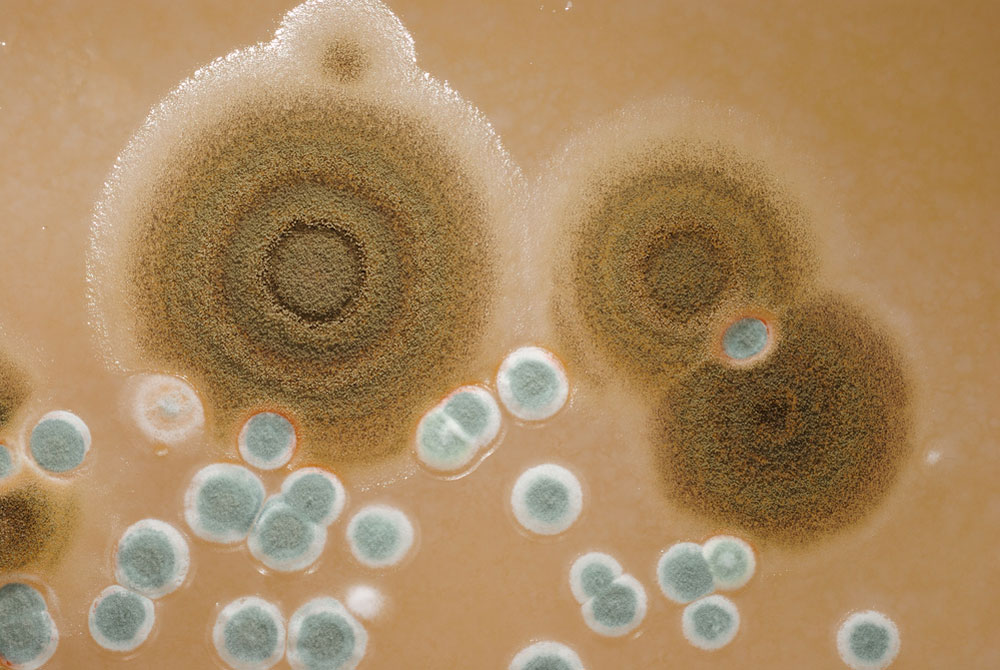
Fungi are sources of important medication. The antibiotics penicillin and cephalosporin, equally well as the drug cyclosporine, which helps to prevent transplant rejection, are all produced by fungi, according to the "Encyclopedia of Biodiversity." All the same by the same token, fungi produce toxins called mycotoxins that are harmful to usa. "Well-nigh all mycotoxins are produced by molds," Volk said. For instance, Aspergillus fungi that grow on corn and peanuts produce aflatoxins. This mycotoxin is considered a carcinogen and has been linked to liver cancer.
Yeast (Saccharomyces cerevisiae) is essential to the fermentation of wine and beer, and to the baking of raised, fluffy bread. The characteristic azure hue of blue cheeses is due to the sporulation of the fungus Penicillium roquefortii, according to the "Encyclopedia of Biodiversity." Mushrooms such as chanterelles and morels are tasty additions to meals. Notwithstanding smut and rust fungi (named for the coaly and rust like advent of their spores) routinely destroy food crops and plants like beans, barley and pine trees, according to "Van Nostrand."
Important scientific discoveries have been made using fungi as model organisms. The discovery that genes control the expression of enzymes, and that one gene controls i enzyme, was a result of experiments with the pink mold Neurospora. Scientists George Beadle and Edward Tatum won the Nobel Prize in 1958 for this piece of work. Yeast has also been used as a model organism for answering questions in the field of genetics. According to a 1997 article published in the journal Science, many yeast and mammalian genes lawmaking for similar proteins, making it a useful tool for agreement the man genome and disease conditions such as Werner's syndrome.
Yet, what we know near fungi today, and what we tin do with fungi, is simply the very kickoff of all that is possible. As Volk states in "Encyclopedia of Biodiversity," in that location are 75,000 fungal species that are named. Only this number is believed to correspond only 5 per centum of the species that exist in nature. "There'south relatively little known about the fungi compared to the animals and plants," Volk told LiveScience. "In that location's still a lot of new species out there to be discovered."
Additional resources
- Encyclopedia Britannica: Fungus
- Tom Volk's Fungi (University of Wisconsin-La Crosse): Extensive database of fungi and interesting stories
- Genetics: Sporulation in the Budding YeastSaccharomyces cerevisiae

Bustling Fungus Risk Of Rain,
Source: https://www.livescience.com/53618-fungus.html
Posted by: gambleannes1991.blogspot.com
0 Response to "Bustling Fungus Risk Of Rain"
Post a Comment